
By CHRISTINE BJERKAN
The 2025 Moroccan Royal Tour began with a flourish in Tétouan, a northern jewel framed by the Rif Mountains and the Mediterranean Sea. Known for its Andalusian-style medina, a UNESCO World Heritage site, and its whitewashed architecture echoing Moorish Spain, Tétouan has always been a cultural crossroads. This September, however, the city became the stage for something very different: The opening chapter of Morocco’s most prestigious equestrian circuit.
From the start, the atmosphere was electric. The Royal Guard’s historic stud farm, with its parade grounds and monumental grandstands, became a theater for both heritage and high-level sport. Over four days, more than 100 riders representing 18 nations converged for competition in CSI1* and CSI4*-W divisions. While the 1* classes allowed rising Moroccan riders and younger horses to take their place, it was the 4* and World Cup qualifier events that drew the loudest cheers. In particular, the Grand Prix that brought the opening weekend to a dramatic conclusion.
A Grand Prix Victory for Morocco
The pinnacle of the Tétouan stage came with the CSI4*W Grand Prix, a class that tested precision, speed, and courage over demanding courses designed by French course-builder Cédric Longis. Riders from across Europe and the Middle East lined up, with Olympic veterans and seasoned Grand Prix contenders vying for the first marquee title of the Tour.
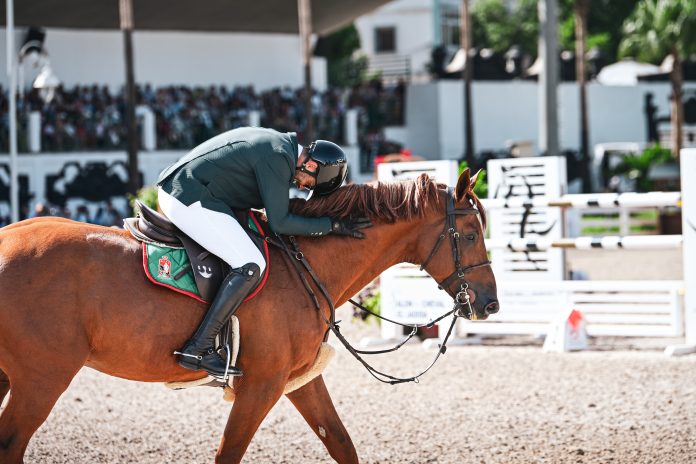
In the end, it was Morocco’s own Abdeslam Bennani Smires who rose above the rest, riding Davino Q to what he called “a dream come true.” His victory was more than a sporting triumph; it was a symbolic moment that showcased the strength of Moroccan riders on home soil. The stands erupted in celebration as Bennani Smires cleared the final fence, Moroccan flags waving high under the floodlights. For local fans, it was proof that the Tour is not only about bringing in international champions, but also about elevating national talent to the highest stage.
The Grand Prix capped off a week of top-level competition that saw other world-class names shine. Saudi Arabia’s Ramzy Al Duhami claimed the Grand Prix qualifier, confirming his place among the region’s most consistent performers. Italy’s speed specialist Emanuele Gaudiano added yet another victory to his glittering résumé, storming to win the 1.50m night class with his trademark bold riding. French rider Nathalie Mack took her first CSI4* win in the Prix de l’Indépendance, a fast opener that set the tone for a competitive week.
Together, these results underscored the international prestige of the Moroccan Royal Tour: Olympic veterans, world-class riders, and national champions all competing on the same stage, in front of crowds that grew larger and more vocal with each evening session.
A Spectacle Under Lights
While the Grand Prix delivered the most important sporting result, Tétouan’s night classes offered some of the week’s most memorable atmospheres. Under floodlights, the stud farm’s arena came alive with the energy from fans in the stands. With free admission, entire families attended, creating an inclusivity rarely seen at this level of the sport.
Children cheered at each jump, waving Moroccan flags as Gaudiano raced the clock and as Bennani Smires soared to his historic victory. For many in the stands, this was their first experience of equestrian sport, making it an experience shared by riders, their teams, and new fans alike. Unlike the quiet exclusivity of some European shows, Tétouan delivered a festival atmosphere, where elite riders were met with the kind of passionate, stadium-style energy usually reserved for major sporting events.
Moroccan Riders Shine in CSI1*
Alongside the four-star events, the CSI1* classes gave young riders and those with less experience the chance to compete in front of the same international audience. On the opening day, home talent dominated, sweeping the top nine places in the Prix d’Oued Draa. Ghita Msefer with Carlotta de Champloue claimed victory, followed by Souleimane El Mandour and Mohammed Nizar Souktani. These results showed the depth of Morocco’s emerging talent.
For riders and horses stepping into international competition for the first time, the Tour provides vital exposure in a world-class setting. For the audience, it reinforces that equestrian sport is not a closed arena but one where future stars can rise from the grassroots.
Culture and Community at the Forefront
Beyond the competition, the Tétouan stage highlighted the Tour’s ability to merge sport with cultural discovery. The city’s UNESCO-listed medina and Andalusian traditions give visitors a sense of Morocco’s rich past, while the Royal Guard’s stud farm delivered world-class equestrian action by night. This blend of heritage and high-level sport created a unique tourism experience, offering international visitors and local families alike the chance to engage with Morocco’s equestrian identity in a way that felt open and inclusive.
Setting the Standard for the Tour
As the opening chapter of the 14th Moroccan Royal Tour, Tétouan did more than set the sporting bar high; it defined the narrative for the circuit as a whole.
For the international equestrian community, Tétouan demonstrated what makes the Moroccan Royal Tour stand out. It is a stage where Olympic champions and local heroes compete under the same lights, where history and modern sport meet, and where equestrianism is presented as a celebration for all, not just for the few. Next, the Moroccan Royal Tour traveled south to the capital, Rabat, for its flagship Nations Cup at the Dar Es Salam complex. To discover how the battle unfolded between international teams, and why Rabat has become the sporting pinnacle of the circuit, head this way.