Brought to you by The Plaidcast
Most horse showing is individual by design. You enter the ring alone. Your score belongs to you, and your ribbon reflects your performance. Even when riders train in the same barn and support one another, the competition itself usually comes down to one horse-and-rider combination against another.
The Interscholastic Equestrian Association turns that model on its head.
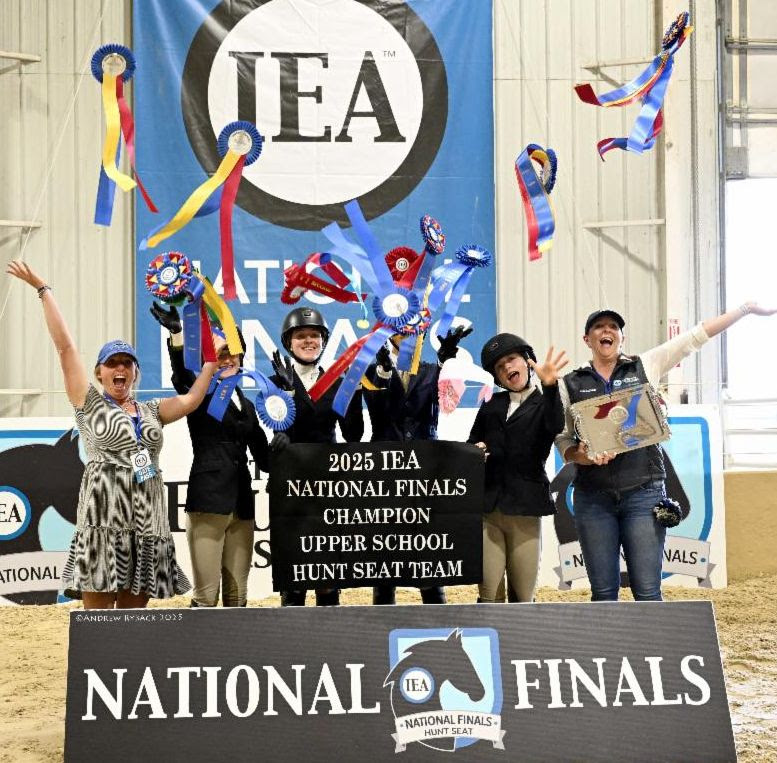
IEA riders compete individually, but their performances can also contribute to a team result. According to IEA co-founder and executive director Roxane Durant, that changes not only how the competition is scored, but also the culture surrounding it.
“The beginner rider has the same effect and points for the team as maybe the open rider does,” Durant said. That creates a version of horse showing where success is not only about your own round. You are also invested in everyone else’s.
On an IEA team, riders compete at different ability levels, from introductory flat classes through the open divisions. But the team structure makes those differences less important than they might seem.
The rider competing at the highest level may have years more experience than the beginner, but each rider can contribute meaningful points. That gives everyone a reason to pay attention to every class. Families and teammates are cheering for the entire team.
Durant compares that atmosphere with other team sports, where athletes understand that each position contributes to the result. That is relatively unusual in an industry where riders are generally accustomed to competing as individuals.
The draw-based format adds another layer.
Riders are assigned horses rather than bringing their own, and the same horse may carry multiple competitors during the day. That can create an unusual situation: the person you are competing against may have information that can help you.
Durant gave the example of two riders in the same class. If one rides the horse first, the next rider may come over and ask how the horse felt. The first rider might tell them.
That kind of exchange reflects the shared challenge built into the format. “There can be this sort of shared camaraderie of, you know, we’re all in this together,” Durant said.
Everyone understands that the draw introduces uncertainty. A horse may be more forward than expected, quieter than expected, or simply unlike what the rider normally rides at home. Instead of pretending that challenge does not exist, riders often help one another navigate it.
At a traditional show, riders may spend months preparing one familiar horse to produce the most polished possible performance. In IEA, riders walk into a very different situation. They do not know exactly what horse they will get or whether it will naturally suit their style.
The challenge is built in. One rider might normally ride a hotter horse and draw one that does not want to go forward. Another may have the opposite experience. Everyone is being asked to adapt.
Durant said that shared challenge often creates camaraderie among riders who are all navigating unfamiliar horses. She described the format as “a little more exciting, a little more fun, a little more challenging.” The uncertainty becomes part of the experience everyone is managing together.
That team structure also changes the physical atmosphere of IEA shows. Durant points out that many traditional horse shows today have relatively few spectators. One professional rider may show several horses, accompanied by a coach, groom, friend, or family member.
IEA reverses the ratio.
Instead of five horses for one rider, Durant says there may be one horse for five riders. That means a relatively small number of horses can generate a very large crowd of participants, parents, teammates, and supporters.
When IEA rents a facility for nationals, Durant may tell organizers to expect around 100 horses. At first, that may not sound like a particularly large event.
Then comes the other number. “We may only have 100 horses, but we’re gonna have 500 people there during that day,” she said. That means more seating, more parking, more food, and more spectators actually watching what happens in the ring.
The team culture also extends across ages and ability levels. IEA teams include younger and older students, and Durant describes the dynamic of an experienced senior open rider supporting a much younger teammate.
“There’s nothing cooler than, you know, that senior rider that’s the open level, that’s like the coolest cool rider on the team, you know, giving support, advice, camaraderie to, you know, the cute little fourth-grader with the ponytails,” she said.
Durant also notes that working with people of different ages, backgrounds, and abilities is something riders can carry into future careers, whether those careers are in the horse industry or elsewhere.
Team competition does not remove individual ambition. Riders still want to perform well, qualify, and win their classes. But the IEA structure gives those individual goals another context. That can teach riders to handle pressure, support teammates at very different stages of development, share knowledge, and celebrate results that do not belong to them personally.
Horse showing may traditionally be an individual sport, but IEA offers a glimpse of what changes when riders are asked to compete as part of something larger.
To hear the full conversation with Roxane Durant and Piper Klemm, listen to episode 486 of The Plaidcast. Subscribe and follow The Plaidcast on your favorite podcast platform for more conversations from throughout our industry.