
Welcome to Trainer Tuesday! Each week we ask trainers a question and gather their answers for you. These trainers have a range of experience, backgrounds, and focus points of their programs, so the answers have as much variation as you would expect and also probably much more similarity.
This week’s question posed is: How can riders improve their spatial recognition off the horse?
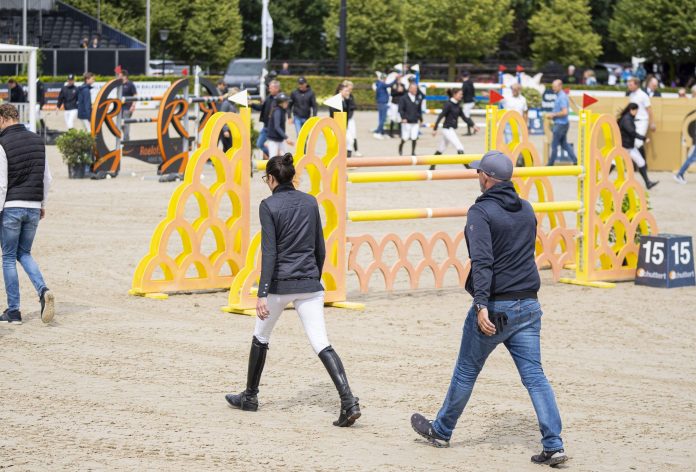
“Spatial recognition has to do with training your eye, and conditioning yourself to measure distances and lines. A lot of times, I’ll have my students make a prediction about how many strides a line is before we walk it, and then compare after walking to see how close we are.
Walking as many courses as possible, at different heights, can help a rider learn to measure distances without actually riding them. This can come in very handy if you have to show in a class and didn’t get to walk the course, for whatever reason, or if you are testing in a medal and they put a new line into the test that you haven’t ridden yet.” -Kyla Makhloghi
Listen to Kyla on The Plaidcast here.
“Riders can improve their spacial awareness off the horse by studying the course from different views. One thing that is important, especially for the newer riders with a harder course, is to study the course at the gate and then go to the other end of the arena and study the course looking at it that way.
It always looks different once you’re at the far end of the ring coming home. Especially if the course is one that allows you to do a course walk, once you get to the far end of the ring, stop your course walk and look back towards the gate and go over your course from that view.
I also like to have a few options for a rollback. Standing at the gate, you might think that you can take the tighter turn rollback. But in fact, once you get on course, it does not ride that way. So I always teach my students to have an option A, B, and C track.” -Cammie Fielding
Read more about Cammie here.
“Something that one of my trainers told me, a long time ago, was to sit and watch as many horses and riders show/ride as possible. By watching all types of horses and ponies go around, particularly over courses, you start to gauge their stride and distances from the jump(s).
While watching, try to start counting when horses are 3 strides out from the jump, then 4, 5, 6 and so on. The more horses that you watch go around, gives you a better perspective of a horse’s stride, rhythm and the type of canter that a particular horse or pony needs to create a great distance and in turn a beautiful jump, as well the correct striding.
If you watch enough horses go, you can usually see ahead of time when a horse is going to come up on the distance a little long or a little short. That’s a place where we as trainers can help coach riders from the ground to either move up or settle in to the distance. A huge Thank You to Thom Pollard for giving me these words of wisdom many years ago!” -Alexandra Vernon
“Memorizing a course on paper, being able to walk it before the class starts, and then watching how others ride the distances really helps improves spacial recognition in jumping. We go in having a pattern and then walk out the distances and see if that pattern is actually accurate.
Sometimes we walk them out how they ride, other times there’s an in-between distance, or it might change as the horse is coming home. Watching others ride it and seeing how some might add or subtract helps myself and my rider decide which would be better for their horse’s success/stride length/etc. For example, in a jump off, we’ll walk off strides from landing to see where the best track would be to turn or where take off should be for an inside turn.” -Cara Wheeler